
NAD+ Supplementation (NMN) Falling Flat? The “Internal Fire” in Blood Vessels Fuels Aging
Science Advances: Endothelial Dysfunction Drives Aging — NAD+ Deficiency Is Not Just About Replenishment, But About Vascular Damage
If you wish to cool boiling soup, one man may keep adding fuel while a hundred stir the soup to dissipate heat; it will be of no avail. The better way is to remove the firewood beneath the cauldron. — The Book of Han
The ancient parable of stirring soup to stop boiling, versus removing firewood from under the cauldron paints a clear picture: when water in a cauldron boils nonstop, people scoop up and pour back scalding broth in a futile attempt to calm the roiling surface, ignoring the burning firewood underneath. With the source flame still blazing, no amount of stirring will stop the boil.
This analogy applies perfectly to NAD+ supplementation. As we age, our endogenous NAD+ levels decline, accompanied by waning physical stamina and memory. Many turn to NMN supplements hoping to slow aging, continuously feeding raw materials into the system — yet see minimal results.
Perhaps the core issue is not insufficient raw material, but the raging fire at the root. A recent study published in Science Advances by the team at the Shenzhen Institute of Advanced Technology, Chinese Academy of Sciences, identifies this new ignition point: age-related NAD+ depletion arises not merely from reduced precursor supply, but also from impaired NAD+ biosynthesis itself. The damage originates from the vascular endothelium lining blood vessels throughout the body.
Vascular Endothelium: Triggering Multi-Organ Aging from Afar
Let us first introduce the key player: the vascular endothelium. A delicate monolayer of endothelial cells lines every blood vessel across our body. It serves as the logistical hub for all organs: delivering oxygen and nutrients, clearing metabolic waste, maintaining the blood-brain barrier, and secreting an array of signaling molecules that regulate inflammation, coagulation and more.
Given these critical roles, researchers examined endothelial changes during aging. Comparing skeletal muscle and cerebral cortex samples from young and aged subjects, they found a marked reduction in endothelial cell count in aged tissues, alongside significantly elevated levels of two proteins within endothelium: C/EBPβ and AEP.
For those unfamiliar with these proteins: C/EBPβ is a transcription factor that modulates inflammatory responses, while AEP is an asparaginyl endopeptidase. Prior research has shown that neuronal C/EBPβ rises with age and subsequently activates AEP. Sustained activity of the C/EBPβ/AEP pathway accelerates neuronal degeneration and shortens lifespan in mice.
C/EBPβ and AEP are not limited to neurons; they are also expressed in peripheral blood vessels. This led to a hypothesis: this pathway contributes to microvessel loss and progressive functional decline across multiple organs.
Correlation alone is not conclusive, so the team ran causal validation. When AEP was selectively overexpressed in mouse endothelial cells, young mice rapidly developed hallmark aging phenotypes: impaired vasodilation, leaky blood-brain barriers, reduced exercise endurance, memory deficits, and drastically shortened lifespan. Male mice saw their average lifespan drop from 706 days to 435 days — a nearly 40% reduction.
Once the vascular endothelium malfunctions, organs across the body suffer cascading harm. Skeletal muscle and the brain bear the brunt first. Senescent endothelial cells also release pro-inflammatory cytokines that circulate via the bloodstream, broadcasting aging signals systemwide.
Ultimately, all these AEP-driven disturbances converge on the NAD+ biosynthesis pathway.
Uncovering the Mechanism: NAD+ Decline Is Not Just Reduced Supply — It Is Active Sabotage
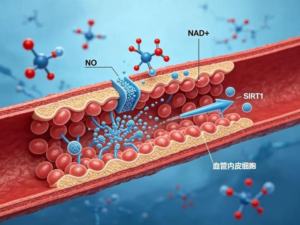
Most endogenous NAD+ is produced via this biosynthetic pipeline: Nicotinamide (NAM) → Nicotinamide Mononucleotide (NMN) → NAD+
The first and rate-limiting step relies on NAMPT (nicotinamide phosphoribosyltransferase), the enzyme that governs overall pathway efficiency. Aging suppresses NAD+ levels, undermining energy metabolism, DNA repair and antioxidant defense. This is why supplementation with NAD+ precursors such as NMN and NR has become a popular anti-aging strategy.
Yet there is a broader perspective. Supplying precursors only works when the “machinery” remains intact. If the machinery is being broken down, it cannot carry out its job.
AEP recognizes and cleaves NAMPT at its N136 site. Cleaved NAMPT loses catalytic activity and can no longer participate in NAD+ production, resulting in insufficient NAD+ synthesis.
Researchers reproduced this damaging process experimentally. In vitro, AEP directly cuts NAMPT. In cellular models, elevated AEP correlates with increased NAMPT cleavage and lower intracellular NAD+. When the N136 site of NAMPT is mutated to block AEP recognition, NAD+ biosynthesis remains largely unaffected.
The puzzle is now solved: With advancing age, C/EBPβ is upregulated in vascular endothelial cells and boosts AEP expression. Activated AEP cleaves NAMPT, crippling endothelial NAD+ synthesis. NAD+ deficiency further disrupts endothelial function and pushes cells into senescence, releasing more inflammatory signals. A vicious cycle forms: deficiency fuels dysfunction, and senescence amplifies inflammation.
We often view hardened arteries and atherosclerotic plaques as mere byproducts of aging. This study sounds an important alarm: endothelial dysfunction may be a driver of multi-organ aging — reversing the conventional cause-and-effect assumption.
From “Stirring the Soup” to “Removing the Firewood”: Shifting From Exogenous Supplementation to Endogenous Repair
If AEP sabotages NAMPT to trigger vascular aging and NAD+ collapse, inhibiting this pathway offers a promising intervention.
1. Genetic Knockout: Robust Rejuvenation
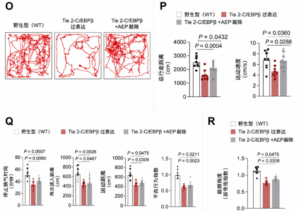
The team created a premature aging mouse model with endothelial overexpression of C/EBPβ, then knocked out the AEP gene in a subset of these animals. AEP deletion restored NAD+ concentrations, improved vasodilation, preserved blood-brain barrier integrity, boosted exercise endurance and memory, and reduced frailty scores.
Lifespan saw dramatic recovery: male premature aging mice went from an average 381 days to 666 days; females rose from 435 days to 643 days, nearly matching the lifespan of wild-type controls.
This confirms that most C/EBPβ-mediated premature aging damage is executed downstream by AEP. Even with high C/EBPβ activity, suppressed AEP prevents severe pathological aging.
2. Are AEP-Inhibiting Therapeutics Available?
Beyond genetic manipulation, the team tested a highly selective proprietary AEP inhibitor in mice and benchmarked it head-to-head against the NAD+ precursor NMN. Both interventions raised NAD+ levels in skeletal muscle and brain tissue, yet the inhibitor delivered a larger NAD+ uplift.
Moreover, the AEP inhibitor outperformed NMN in improving vasodilation, repairing blood-brain barrier leakage, dampening inflammation, enhancing motor and cognitive performance, and extending lifespan.
Long-term inhibitor administration showed no obvious hepatic or renal toxicity in mice. Critical note: these results are derived from animal studies. Human safety, efficacy and optimal dosage still require formal clinical trials. Even so, this laboratory evidence delivers a clear takeaway: we must not only focus on replenishing precursors while ignoring the root cause of NAD+ loss.
Should You Keep Taking Your Supplements? How Do You Protect Your Vascular Endothelium?
Does this cast NMN supplements in a negative light? Let us clarify practical guidance.
NMN and other precursors do supply building blocks to support NAD+ synthesis. However, a damaged, senescent vascular and cellular microenvironment limits their efficacy, which explains why many users notice weak or inconsistent effects.
The C/EBPβ/AEP pathway creates multiple barriers beyond NAMPT breakdown:
- Senescent endothelial cells have impaired NMN uptake and transport capacity
- Inflammation and accumulated DNA damage accelerate NAD+ consumption
- Microvascular rarefaction limits delivery of circulating NMN to target tissues including muscle and the brain
This makes preserving endothelial health indispensable. Common lifestyle stressors — prolonged high-sugar, high-fat diets, smoking, chronic sleep deprivation and sedentary behavior — injure the vascular endothelium, indirectly accelerating NAMPT degradation and NAD+ depletion. Rather than chasing shortcuts through supplements, consistent aerobic exercise, glycemic and lipid control, and balanced nutrition safeguard endothelium and protect native NAD+ metabolism.
The mindset of “replenish whatever is lacking” is incomplete. Blindly chasing popular supplements can become an exercise in stirring boiling soup. Protecting vascular health and preserving the body’s innate repair and metabolic capacity may represent a more sustainable, long-term anti-aging strategy — the true removal of firewood from beneath the cauldron.