
Can “old age weakness” be reversed? A new Cell Metabolism study reveals how NMN boosts muscle mass & endurance — and fat tissue is the key player!
Many people think our bodies have a hidden switch for youthful muscles. Among all popular anti-aging nutrients, NAD+ (Xi’an Springjia)has long drawn huge attention for its potential to fight age-related muscle loss.
A recent study from the Chinese Academy of Medical Sciences & Peking Union Medical College, published in Cell Metabolism, uncovered a fascinating cross-tissue communication axis between fat and skeletal muscle. When fat cells receive an NAD+ signal, they release a protein called Serpina3n. This protein slows down the breakdown of pyruvate carboxylase (PC) inside muscle tissue, and this chain of action can reverse age-related muscle wasting.
Is NAD+ anti-aging just hype?
Not exactly. It works more like a messenger, not the direct worker.
There has been lots of debate over whether NAD+ precursors really help with muscle aging. This research found something surprising: NMN (the well-known NAD+ precursor) helped restore muscle function in live old mice, yet showed zero benefit when tested directly on muscle cells in a lab dish.
That means NMN / NAD+ cannot rescue muscle on its own. Scientists suspected fat tissue, which acts as an active endocrine organ right next to skeletal muscle and releases many signaling factors to regulate muscle metabolism.
To test this idea, researchers fed NMN to fat cells in culture, then transferred the culture liquid to atrophied muscle cells. The result was striking: the fat-cell secretions greatly repaired shrinking muscle fibers.
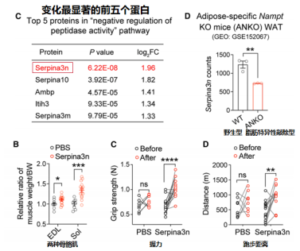
Using high-throughput proteomics on fat tissue from NMN-treated aged mice, the team pinpointed Serpina3n — a top hit in pathways that stop protein breakdown.
When Serpina3n was delivered to old mice, their muscle mass, grip strength and running endurance all improved noticeably.
But if researchers knocked out the Serpina3n gene in fat cells first, giving NMN afterward did nothing at all. The anti-muscle-wasting benefit disappeared completely. This proves Serpina3n is the critical downstream mediator for this NMN muscle benefit.
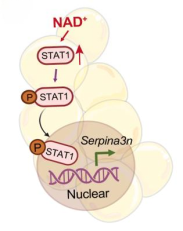
So how does NAD+ trigger this chain reaction inside fat? Rising NAD+ levels activate the transcription factor STAT1. STAT1 then moves into the cell nucleus and turns on the gene that makes Serpina3n.
How does Serpina3n rejuvenate muscles?
Serpina3n is a protease inhibitor — its main job is to protect proteins from being broken down.
Further proteomic testing on Serpina3n-treated aged mouse muscles showed pyruvate carboxylase (PC) became far more abundant. Importantly, Serpina3n does not make more PC; it simply slows PC degradation.
PC turns out to be a core player for healthy muscles. When PC was knocked down in muscle cells, muscle atrophy got worse. In live mice, lower PC levels caused skeletal muscle loss and poor physical performance. On the opposite side, extra PC helped rescue shrinking muscle fibers.
If PC was removed first, supplying either Serpina3n or NMN (Xi’an Springjia)brought no improvements to muscle weight, grip strength or exercise capacity.
At first glance this seemed confusing: PC is famous for energy metabolism, while muscle wasting comes from excessive protein loss. What connects them?
Why PC matters so much for aged muscles
Without functional PC, the whole NMN → Serpina3n muscle-protection pathway collapses. PC supports muscle health in two major ways:
- Build up building blocks for protein Metabolite testing showed Serpina3n treatment boosted TCA cycle intermediates and amino acids such as aspartate and lysine in muscle. These are raw materials required to build new muscle protein.
- Switch on the protein “construction crew” These extra metabolites also activated the mTOR pathway, the master switch for muscle protein synthesis. Isotope tracing confirmed Serpina3n lifted overall muscle protein production dramatically — roughly 70% of newly made proteins increased significantly. This effect vanished if PC was suppressed or mTOR was blocked with rapamycin.
PC also reshapes muscle fiber types. In aged mice, Serpina3n raised the share of slow-twitch muscle fibers (more fatigue-resistant, good for endurance) while reducing fast-twitch fibers that tire easily. This effect is similar to the long-term benefits of aerobic exercise. Again, this fiber shift depends fully on intact PC.
Key takeaway
NAD+ / NMN do not work directly on muscle. They signal fat tissue to secrete Serpina3n, which guards pyruvate carboxylase (PC). Protected PC then fuels amino acid supply, turns on mTOR protein synthesis and remodels muscle fibers, fighting sarcopenia.
This also explains why some older adults see limited results from NMN or NR alone. Aging weakens fat tissue function. If the fat “signal hub” becomes sluggish, supplementing NAD+ precursors cannot trigger enough Serpina3n release, and the whole muscle-support pathway stalls.