
Vitamin B12 Rich Diet + Proper Methionine May Extend Lifespan by 50%? Activating Mitophagy Is The Secret!
Everything in nature has checks and balances, and this rule also applies to biology. Some substances boost each other to keep energy and nutrients cycling. Others work to limit one another and maintain healthy balance.
A new study published in Nature Communications[1] uncovered such a balancing pair that controls lifespan in roundworms. The rict-1 gene puts a brake on how roundworms respond to dietary vitamin B12. Once this brake is removed, a longevity pathway lights up. This chain links methionine metabolism, succinate and mitophagy together.
Vitamin B12 and Methionine: Working As A Team?
There are many anti-aging strategies, yet diet is one of the easiest things we can adjust in daily life. Foods like meat, eggs and dairy are rich sources of vitamin B12 (Xi’an Springjia)and methionine. But studies have drawn mixed conclusions on how these foods relate to aging.
Some research shows moderate methionine restriction supports metabolic health and slows aging[2]. Another B12 study found roundworms with the flr-4 gene mutation were extra sensitive to food vitamin B12. When fed B12-rich food, their lifespan increased by roughly 30%[3].
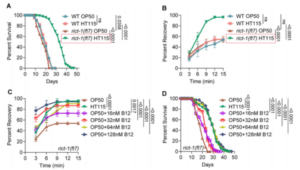
So why does vitamin B12 bring longevity benefits only under certain conditions? The same research team studied rict-1 mutant worms. They found that only on a B12-rich diet could rict-1 mutants live around 50% longer and better resist high salt stress.
Scientists believe the protein made by rict-1, RICTOR, acts like a buffer. It lowers how strongly roundworms react to changes in dietary nutrients such as B12. Without RICTOR, this buffer disappears, and metabolic reactions related to B12 become much stronger.
The connection between B12 and methionine lies in the methionine cycle. Vitamin B12 helps make methionine, and this cycle supplies key methyl groups needed by cells.
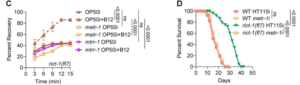
Within this cycle, B12 helps the enzyme METR-1 turn homocysteine into methionine. If metr-1 is knocked down, rict-1 mutants lose their stress resistance and longer lifespan gained from high B12 food. This tells us B12 cannot deliver benefits without a working methionine cycle.
What is surprising is that the bacteria eaten by roundworms also take part in this process. When fed bacteria with broken methionine cycles, rict-1 mutants no longer get longevity benefits. Adding methionine or homocysteine brings those benefits back, while adding SAM does not work.
This proves a fully functional methionine cycle is required to keep producing methionine for the worms. SAM alone cannot turn into methionine when the cycle is broken.
All these complex metabolic reactions feed into the TCA cycle and create succinate. When the key enzymes making succinate are reduced, the stress resistance and lifespan advantage of rict-1 mutants drop sharply. Adding succinate back restores those benefits again.
What Does Succinate Do?
Researchers saw that adding vitamin B12 or methionine greatly raised succinate levels inside rict-1 mutant roundworms.
Since these metabolic enzymes mainly sit inside mitochondria, the team checked mitochondrial shape. On B12-rich food, mitochondria in rict-1 mutants split into smaller fragments. On low-B12 food, their mitochondria stay connected and tube-shaped. Wild-type worms did not show this clear shift.
This fragmentation is not harmful for these roundworms. If the gene controlling mitochondrial splitting is knocked down, rict-1 mutants lose their lifespan advantage. Extra B12 or methionine can no longer restore their stress tolerance.
Mitochondrial splitting is not the end of the story. Some broken small mitochondria get identified and cleared away through mitophagy. On B12-rich diets, rict-1 mutants show much higher mitophagy activity. If core autophagy genes are knocked down, their stress resistance and longer lifespan are lost. Even direct succinate supplementation cannot rescue this effect.
Since mitophagy is required for longer life, when does this mechanism work? Scientists tracked the worms through their whole life. For rict-1 mutants eating B12-rich food, mitochondrial fragmentation is more obvious early in life. By day 5 and day 10 of adulthood (later life stage), more connected, tube-shaped mitochondria remain. In contrast, wild-type worms have steadily more fragmented mitochondria as they age.
Along with the change in mitochondrial shape, mitophagy levels follow the same pattern. Throughout their whole life, rict-1 mutants on B12-rich diets keep strong mitophagy. Wild-type worms maintain low mitophagy no matter what they eat.
This means rict-1 mutants do not simply create more broken mitochondria. Instead, active splitting and mitophagy in early life continuously refresh mitochondria. As a result, they keep more healthy tube-shaped mitochondria in old age.
Closing Thoughts
This study helps us clear up confusion around methionine and vitamin B12. These nutrients are neither good nor bad in absolute terms. The outcome depends on genetic background and which metabolic pathway gets activated.
When it comes to our daily meals, there is no one-size-fits-all rule for eating meat, eggs and dairy.
Many people know Liu Xiaoqing. Well into her 70s, she keeps strong energy and vitality, outperforming many younger adults. She shared on TV that women should eat plenty of meat, eggs and dairy. She can finish a whole fish and eats liver three to four times per week.
Liver is among the common foods highest in vitamin B12, and it also supplies enough methionine. However, liver is extremely high in vitamin A and cholesterol. Following the Chinese Dietary Guidelines (2022), animal liver can be eaten 2–3 times each month, with small portions each time[4].
XI’AN SPRINGJIA focuses on premium nutritional raw materials that support healthy aging. We keep tracking cutting-edge longevity nutrition research to help you understand how nutrients work inside your body.